Nirmala Sitharaman wore a red and off-white silk sari with ikat patterns


We all love our favorite handloom products ! Be it the luminous silk or the feather-light cotton, every handloom product is exceptional. It is the creativity of every skilled craftsman that is imbued in every handloom saree. It is undeniably true that every finely-crafted handloom piece always wins the creative battle over the machine-made. Although, we know they cost a little higher than the other machine-made products. But that is because of the time and skill that goes in weaving a product and the amount of hard work and effort of the craftsman.
The time that goes to weave a complete product goes from 20 days to up to 2 months depending on the pattern. Moreover, the skill of weaving is safeguarded and is passed down generations. It is painstakingly done by hand and isn’t a fast-paced job. One wrong wrapping technique and the whole design could get ruined!
Most of the handloom products are made with naturally produced and procured raw materials and dyes. They are not only environmentally friendly but also are skin-friendly through the hot climate or summer days. As the natural raw materials are chemical-free and toxin-free, they do not have a bad effect on your skin when you sweat. Procuring and processing the raw material again takes a lot of effort and time.
The best part about handloom products is that they are durable and sustain a long time as they are made from the natural fibers. With naturally procured raw materials, these handloom products sustain through decades. Also, handloom sarees are now back in trend! In fact, many designers now are turning back to the roots and prefer opting for handloom pieces for their collections. It is for sure that the uniqueness of a handloom piece is rare and beautiful.
With all that said, even if these products are expensive, they are one of a kind. With artisans pouring their hard work, time, and effort to weave a product is worth appreciating! There is a high probability that you won’t find two exact products and that’s the beauty of a unique handloom product. So next time you pick a handloom product, know that some artist has poured a lot of efforts to weave it.

Designers Kshitij Jalori, Aratrik Dev Varman, Sweta Tantia and Bodice’s Ruchika Sachdeva answer some of the most pressing questions on handloom
Why is handloom a preferred product when I can buy synthetic fabrics that feel smooth and last long from the high street?
Aratrik Dev Varman: They also come from a long and ancient tradition which distinguishes different communities from each other and gives each a distinct identity. They can be as narrow as four inches in Tripura, or be woven as nine yard saris in Kanjeevaram.
The tag on something handmade is always followed by a few zeros. Millennials who are either young adults finding their feet in their respective fields or starting families, or perhaps still students, can’t afford the luxury of handmade. Can the price tags on these garments be validated?
Kshitij Jalori: Generally speaking, handloom fabrics tend to be more expensive than the synthetic mill counterparts owing to the hand labour involved and limited production capacity when compared with power looms. Not all handlooms are expensive, and it totally depends on the fabrics or the yarns being used. Sometimes, it also depends on which region the handlooms are coming from, as techniques of weaving differ from place to place.
Sweta Tantia: The level of artistry and intricacy achieved in handloom fabrics is unparalleled, with certain weaves and designs still beyond the scope of modern machines. While India provides about 95 per cent of hand-woven fabric in the world, sadly there is very little demand for handloom products in our country.
How do you make handloom more exciting for a millennial?
Kshitij Jalori: With the current buzz around handloom textiles, there is more demand for it [now] (some more than the others) than at any other given point of time, but simultaneously the quality of handloom is deteriorating day by day. A lot of power loom fabrics are getting passed off as handloom, thus giving genuine handloom fabrics a stiff price competition. For the longest time, we’ve seen Indian handloom fabrics being limited to ethnic wear. Educating the new-age customer through presentations and group travels to certain [artisan] clusters to actually showcase the painstaking work that is put into the development of these fabrics, will ensure the growth of this industry.
Sweta Tantia: Every craft takes time to execute as it involves complete human involvement, so unless [the artisans] get the right buyer who is ready to pay a price for their skill, it does not lead them to earn what they deserve. So, when we choose a handcrafted product by paying its right price, we are indirectly encouraging the artisans to continue to practice the art, thus saving it from entering the endangered list.
Aratrik Dev Varman: The secret to appreciating handloom cloth is in its touch. The unevenness of the hand and spontaneity with which patterns can be created are far more diverse than machine-made cloth.
Handloom equals simplicity and ethnic wear. What are some common misconceptions you’d like to clarify?
Kshitij Jalori: A common misconception that I believe has been alleviated in the past couple of years is that [handlooms] are only good for ethnic wear. I believe with use of the right construction techniques and a good understanding of silhouettes, handloom fabrics can be used for a wider variety of clothing.
Ruchika Sachdeva: As it is a hand-woven fabric, it might have some irregularities that arise on account of being made by hand. But these are intrinsic to the beauty of the textile and should not be considered as defects.
Aratrik Dev Varman: That handlooms are boring or old-fashioned and need to get sexier. I think we need to educate the customer better and appreciate the sophistication that a weaver embeds into traditional designs.

The strength of Handlooms lies in innovative design, which cannot be replicated by the Powerlooms Sector.
Handlooms constitute a timeless facet of the rich cultural heritage of India. As an economic activity, the handlooms occupy a place second only to agriculture in providing livelihood to the people. The element of art and craft present in Indian handlooms makes it a potential sector for the upper segments of domestic and global market. However, the sector is beset with manifold problems such as obsolete technologies, unorganized production system, low productivity, inadequate working capital, conventional product range, weak marketing link, overall stagnation of production and sales and, above all, competition from powerlooms and mill sector. As a result of effective Government intervention through financial assistance and implementation of various developmental and welfare schemes, the handlooms sector, to some extent, has been able to tide over these disadvantages. The production of handloom fabrics has gone up to 6536 million sq. meters in 2006-07, from 500 million sq. meters in the early fifties. During 2007-08 (upto Oct. 2007), the production of cloth is 4001 mn. sq. mtr. and it is expected to reach 7,074 mn. sq. mtr. by March 2008. The sector accounts for 13% of the total cloth produced in the country (excluding clothes made of wool, silk and hand spun yarn).
Handlooms form a precious part of the generational legacy and exemplify the richness and diversity of our culture and the artistry of the weavers. Tradition of weaving by hand is a part of the countrys cultural ethos. Handloom is unparalleled in its flexibility and versatility, permitting experimentation and encouraging innovation. Weavers with their skillful blending of myths, faiths, symbols and imagery provide their fabric an appealing dynamism.

Mahatma Gandhi emphasized on the use of Khadi and later Khadi Village industry was started on his name. However, gradually people started loosing interest in Khadi but in the last few years people have started showing interest in Khadi products again. Prime Minister Narendra Modi also talked about Khadi in his `Mann ki Baat` program. Surprisingly, masks are the best-selling Khadi products followed by fabric, honey and groceries and then handkerchiefs.
Mahatma Gandhi emphasized on the use of Khadi and later Khadi Village industry was started on his name. However, gradually people started loosing interest in Khadi but in the last few years people have started showing interest in Khadi products again. Prime Minister Narendra Modi also talked about Khadi in his `Mann ki Baat` program. Surprisingly, masks are the best-selling Khadi products followed by fabric, honey and groceries and then handkerchiefs.
Despite coronavirus spread, people are visiting Khadi India outlets every day to buy Khadi products. Handmade indigenous `Khadi` cloth is preferred among Indians as a legacy of Mahatma Gandhi.
People have started to like Khadi products after repeated appeals of Prime Minister. The number of people who like Khadi and shop for Khadi products is increasing every day.
Khadi and Village Industries Commission chairman Vinay Kumar Saxena told IANS, “After Prime Minister Narendra Modi`s appeal, sales at Connaught Place store was recorded to be of Rs 1.02 crore on October 2. On last Saturday, sales was recorded to be of Rs 1,05,26,000. Production has increased by 115.13 per cent in the last six years and sales have gone up by 178.89 per cent. On an average there is a 30 per cent increase in annual sales.”
He said, “We have 11 outlets in Delhi and we are getting good response at all the stores. The operations were closed during the lockdown but people are coming since the restrictions have been lifted. Our online products sales have also increased. Online product sales started on July 8. Currently, 700 products are available online.”
Saxena said, “People are liking footwear, pickles, papad, honey and masks etc. The top selling products are masks followed by fabric, honey and grocery and then handkerchiefs.”
He said, “Prime Minister Modi mentioned about Khadi seven times in Mann Ki Baat. That is why people have started buying Khadi items.”
Saxena said, “We are also selling lamps which are made in Pokhran, Rajasthan.”

Khadi revival is not witnessed as a ‘current’ revolution in India. In fact, as cyclical as fashion is, it isn’t a wonder that khadi regained status and turned a political statement-making cloth to a sartorial one. A handspun fabric mostly woven out of cotton (at times even from silk or wool), khadi has seamlessly made it to young India’s fashion scene, and has now acquired a space in the millennial wardrobe. In fact, khadi is now branded for the urban chic, those with a contemporary and Indian style nuance.
If statistics are to go by, according to Khadi and Village Industries Commission (KVIC), khadi has increased its fabric production by 38.30 million sq metres, registering 37.1 per cent growth, in the last four years. These are definitely soaring numbers for a fabric once branded ‘just desi’. In fact, it is this remarkable growth that has given KVIC reason to plan global stores in Paris and Dubai.
Comfortably Chic
Among the many reasons that have helped khadi retrieve popularity, comfort is the major factor. Ramya Iyer, 34, a long-time user of khadi, says, “Khadi is a summer-friendly fabric, and has an extremely sophisticated look and feel.” The fabric is not just soft and easy on the skin; it also works best in the most humid climes, like ours in India.
Another lover of the fabric, Bushra S Khan, 31, reiterates, “First of all, I love wearing cotton as I live in a humid city [Mumbai], and I think cotton, especially khadi, is the best fabric to wear when you’re witnessing the coastal weather in India.”
More than just comfort
Of course the comfort factor is of primary importance when it comes to choosing khadi. But there are many other aspects people look to when it comes to using this fabric for their attire. Khan adds, “As far as khadi is concerned, I love its understated elegance.
Sometimes, dark or bright colours can be quite an eyesore, especially during summer. Khadi comes in hues that are extremely soothing to the eyes. Also, it is quite an easy fabric to work with, and has variety. The fabric has come a long way from what it used to be; it is soft, and moulds itself according to the body.”
Khadi, which was once a coarse fabric, has way too many variations when it comes to the weaves. We asked designer Resham Karmchandani, co-founder of The Pot Plant, a brand that uses khadi for its contemporary, gen-next pieces, to shed some light on the fabric. She states, “As far as the fabric goes, khadi has various beautiful weaves and is also extremely comfortable as a fabric. People eventually end up buying khadi a lot more as it is trans-seasonal, and offers value for money.”
Another specific reason why khadi is a favourite among youngsters is the luxe feel the fabric offers. A stylist by profession, Sheena Chandwani, 25, agrees, “Not only is khadi easy to wear, as a fabric it looks very upscale. Khadi has a premium feel to it. And from a styling perspective, it can be moulded in many ways depending on one’s persona.”
While it is a luxurious-looking fabric, does the weaver get enough given it is handspun? Designer Rina Singh, founder of Eka mentions, “Khadi is a handspun and handwoven fabric.
Given it is made by a weaver by hand, the price for it should definitely go up, and it should be treated as a luxurious item. As it uses one of the most primitive methods of fabric-making, the novelty factor should go up. In fact, I think the ambar charkha way should also qualify as khadi.”
‘Made In India’ novelty
Influence of a young breed of designers who are working with this hand-spun fabric is also why millennials have given a sartorial nudge to it. Karmchandani states, “I think it all started with the sustainable movement gaining momentum in the country.
Most designers are now keeping in mind the younger generation while designing pieces, and that’s why millennials are more receptive to the fabric. Also, now there’s an entire younger crop of designers who are working with natural fabrics.”
When it comes to the resurgence of khadi, the Internet, especially social media, has definitely served as a medium for its traction. In fact, it is one of the many reasons responsible for making khadi a trusted fabric among the millennials. Karmchandani states, “Everybody’s talking about the use of khadi through social media, and there is a lot more awareness about it now.”
Does the allure of desi and the spike in the acclaim of ‘homegrown’ have anything to do with how welcoming the young crowd is when it comes to this fabric? Iyer adds, “Yes, the fact that it comes with the ‘Made In India’ tag helps.”
Given the language of design and culture is so important for this generation, khadi has an added advantage. Singh states, “Design is a very intrinsic part of our society. As far as urban millennials go, they are aware of what is going on. That said, designers have played a big role in khadi’s popularity with some of us having handheld the craft no matter what the season. The language of design is presented glamorously, and Bollywood has taken it up too, thus it has become a cult movement. Millennials are connected on Instagram and it is a need for them to have their own identity and individuality. What one wears is an important point to make on social media. Clothing is an identity issue for youngsters. There’s nothing better than a homegrown fabric like khadi to define the Indian millennial.”
1]Comfortable: Khadi is one type of fabric that can be worn in any weather. It’s warm in the winters and cool in the summers.
2]Quality: Khadi is a body-friendly fabric which does not cause any allergies or irritations, unlike other synthetic fabrics.
3]Unique appeal: Khadi dyes and weaves are done by hand. Each khadi product is different and has a very peculiar style and finish. Wearing khadi products makes you stand out in the crowd and gives you a unique appeal.
4]Maximum air permeation: The loom used in the making of khadi combines the threads in such a way that allows maximum air to permeate, which is very soothing, especially in summers.
5]Durability: Khadi products are highly durable and long-lasting, thus defining your fashion sense for an extended period of time.
6]Eco-friendly: The making of khadi is eco-friendly, as it does not rely on any electric unit and manufacturing processes and it is purely handmade.

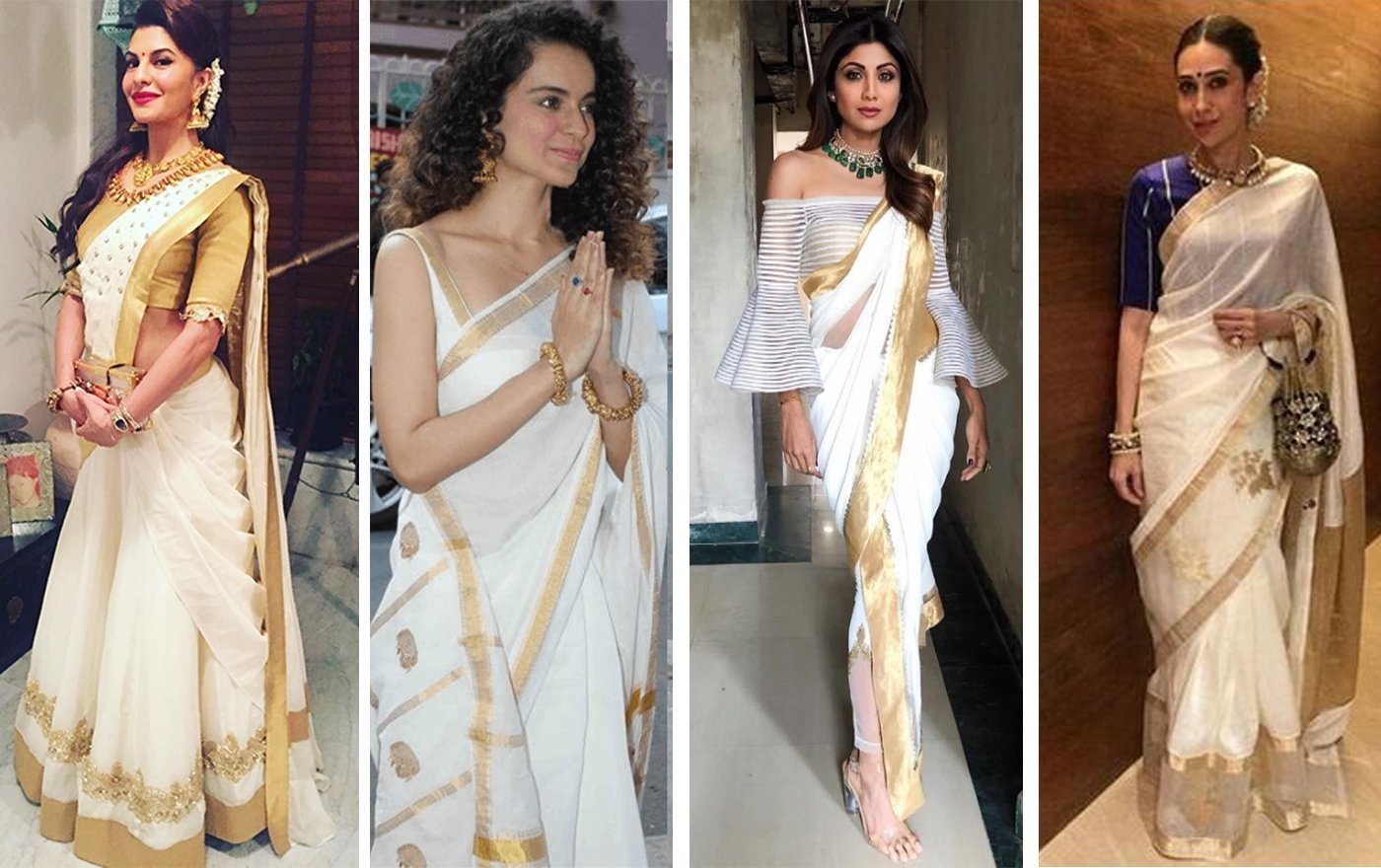
Chendamangalam Cluster, another center of traditional handloom weaving, produces the traditional varieties of clothing, Dhotis and Set Mundu. The Set Mundu or Mundum Neriyathum is a combination of Mundu (or Dhoti) for covering the lower part of the body and Neriyathum to wrap around the upper portion of the body like a Dupatta over the blouse. The Set Mundu is the traditional clothing of women in Kerala and is the oldest remnant of Saree. The Set Mundu consists of two pieces of cloth, the Dhoti or Mundu and Neriyathum or Kavani. The history of Chendamangalam handloom is closely associated with the Feudal Family of Paliam, whose eldest male members, had been the Chief Ministers of the Rajas of Cochin and represented the Perumpatappu Swarupam. The handloom weavers of the village had been patronized by successive Paliyath Valiyachans, the head of the family. In the early days of its origin at Chendamangalam, the weaving of handloom clothes was mainly done for the members of the Paliam family. The women of this family used to show off their dignity in dressing by wearing the Puliyilakkara Neriyathum, Kasavu Dhoti, Kasavu Sarees and other varieties of Chendamangalam handloom products. It was due to the high degree of excellence in the dexterity of fabrics manufactured by the weavers at Chendamangalam.
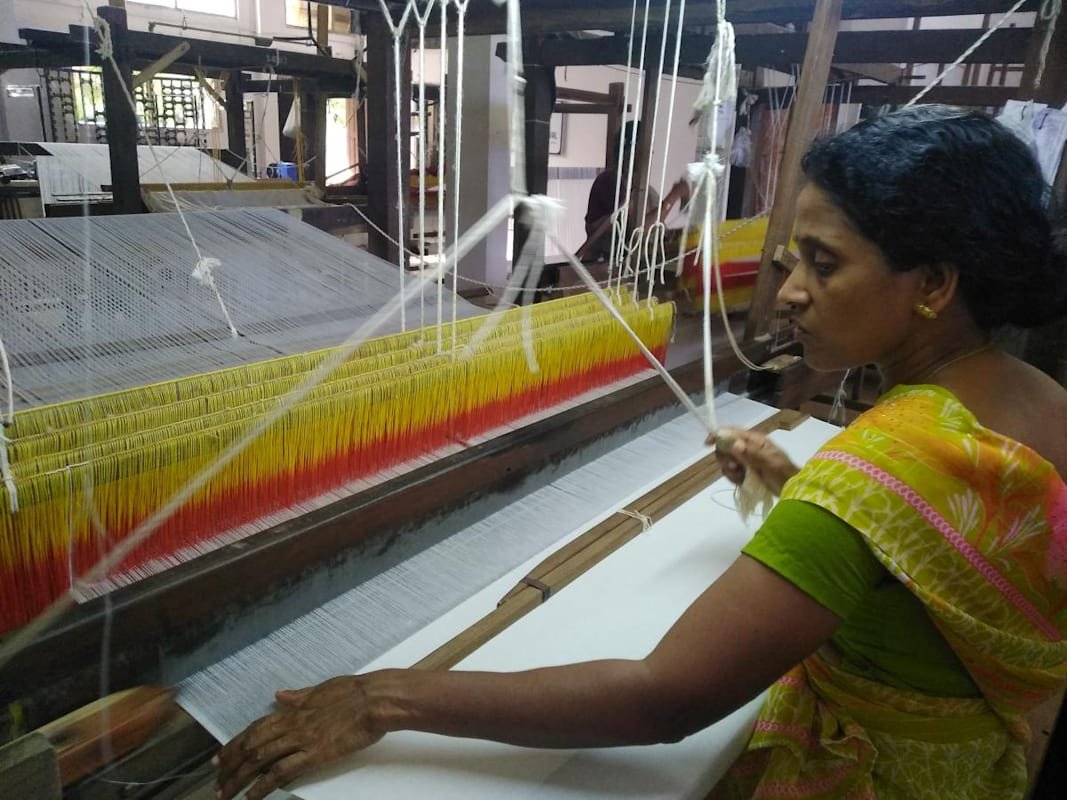
Besides undistributed uniform clothes, stock worth ₹10 crore remains to be sold
The handloom industry in Ernakulam district, mostly centred around Chendamangalam in Paravur taluk, is in dire straits, as a large stock waits to be sold. Besides, the distribution of free uniforms to students has been disrupted thanks to the COVID-19 outbreak.
The free uniform distribution programme was the mainstay of the handloom industry, which was seriously hit by the floods in 2018 and 2019 and the pandemic, said T.S. Baby, president, Paravoor Handloom Cooperative 3428. It is a matter of serious concern that uniforms could not be distributed, as schools had remained closed since March 2020.
An official of the Industries Department said the handloom sector had been in serious financial crisis since the 2018 floods. However, it could be revived through measures including those supported by voluntary agencies.
Ajithkumar Gothuruth of Handloom Cooperative H131 at Paravur said the government had been supportive of the societies, but the weavers lost both Onam and Christmas / Ramzan sales owing to the COVID-19 breakout. Onam season accounts for around 40% of sales during the year, and the loss due to the pandemic has had a huge impact on weavers’ income, he added.
Industry sources said around 70 lakh metres of uniform clothes were produced for distribution in the State, but the pandemic disrupted the plans.
Along with uniform clothes, the industry has stock worth around ₹10 crore, said Mr. Baby, who has worked closely with handloom cooperatives in Paravur. He added that those engaged in weaving had received support from the government.
Handloom societies too suffered widespread damage during the 2018 floods. Mr. Baby said yarn worth around ₹35 lakh was lost in the floods, and that no support was forthcoming for the societies despite repeated appeals by weavers.

Your handloom and handwoven garments need dry cleaning when:
TIP: Consider drying your handloom garment in ventilated shade or air dry it to keep your clothes fresh for use up to couple of times before washing again.
SHRINKAGE: Handloom fabrics are prone to moderate shrinkage on the first wash. Expect up to 5-10% shrinkage with time depending upon how you care for the garment.
BLEEDING: Handloom and handwoven fabrics often bleed colour on the first few washes. Rub a wet cotton swab on the inside of seam or hem, and check if the fabric transfers dye into the cotton.
If the garment shows tendencies to bleed, wash it separately the first few times. It is also advisable to sort your clothes color wise and wash the same colors together. Never mix colors with whites. Turning the clothes inside out helps in retaining the color in the long run.
It is advisable to hand-wash your handloom garments for longevity. If hand washing your clothes is demanding, machine wash on gentle cycle is an alternative option.
Always use cold water to wash handlooms & handweaves.
Standard machine wash protocol: Close all the zippers, hooks & other fasteners before washing.
Never-ever put your handloom or handwoven clothes in a machine dryer.
SOAKING: Use mild detergent and cold water. Do not soak the clothes for too long. Wash the clothes immediately after soaking.
RINSING: Rub the dirty areas gently with hand. Never use a brush, scrub or a solid bar of soap directly on your handloom garments. Remove the detergent completely by rinsing a few times in cold water. Using diluted starch solution for the final rinse give a crisp finish.
Hang to drip dry your handwoven garments in well ventilated evening settings or shade since direct sunlight causes color fading.
Iron your cottons when still damp. Spray water to dampen the fabric if completely dry. Woollens are relatively more crease resistant and you can use steam if necessary.
Store your clothes in cool and dry place with no direct sunlight. Use scented satchels to ensure your clothes don’t pick up cupboard odor. Store silks in cloth covers.
Finance Minister Nirmala Sitharaman stepped out today to present the Union Budget 2021-22 in the Parliament. For the occasion, Sitharaman wore a red and off-white silk Pochampally sari with ikat patterns around the pallu, with a green border. This was paired with a matching red blouse.
Pochampally ikat is traditionally made in Bhoodan Pochampally, in Telangana, and is popularly known as the ‘silk city of India’. According to pochampally.com, the manufacture is this style of silk sari goes back to 1970s when it was decided by some village headmen of Pochampally to weave silk along with cotton.
Pochampally is known by various names locally, in Telangana, like Pogudubandhu, Chitki and Buddabhashi. The fabric is cotton, silk and sico — a mix of silk and cotton.
Meanwhile, the Indian government, including Prime Minister Narendra Modi himself, have been urging citizens to promote traditional handloom and weaving sectors by wearing locally manufactured garments, as part of the “vocal for local” initiative.
Celebrities, from Kangana Ranaut to Priyanka Chopra, also recently encouraged citizens to wear handloom attire.